





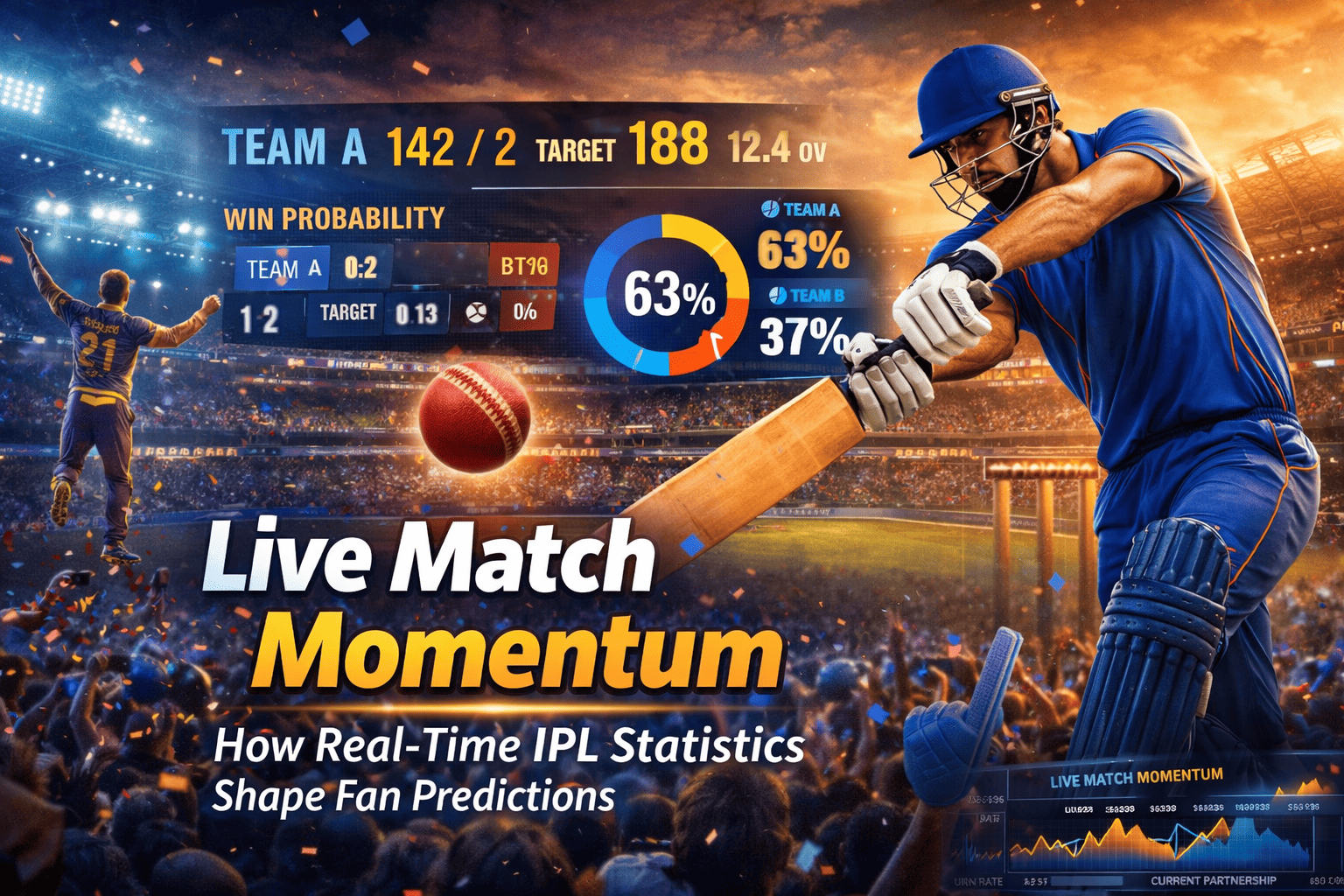
IPL matches do not feel stable for long.
One over changes the mood. A quiet powerplay becomes a collapse. A slow chase turns explosive in six balls. That speed is why live statistics matter so much.
Fans do not watch numbers passively. They use them to build predictions in real time.
A rising run rate suggests control. A cluster of dot balls suggests pressure. A strike rate above 180 changes how viewers read the next over. The scoreboard becomes more than record. It becomes evidence.
This is how momentum works in T20 cricket.
Momentum is not magic. It is the visible pattern of small events stacking quickly. A boundary, a wicket, a dropped catch, a tight over. Each event shifts belief.
Live IPL statistics sharpen that shift. They give fans concrete signals during uncertainty. Instead of saying “this team feels ahead,” viewers can point to the required rate, the death-over economy, or the left-right batting combination at the crease.
This article examines how real-time IPL numbers shape fan expectations, why momentum feels stronger in short-format cricket, and how live data turns spectators into active interpreters of the match.
Why Real-Time Numbers Change How Fans Read The Match
Live cricket statistics act like signals on a dashboard. They tell viewers what direction the match is moving before the result appears.
In T20 cricket, the scoreboard updates every ball. That speed creates a constant flow of information. Fans watch the numbers and adjust their expectations immediately.
The run rate is the first signal.
A batting side scoring nine runs per over looks stable. If that rate drops to six within three overs, the mood changes. Viewers sense pressure building. Even without commentary, the numbers reveal the shift.
The required run rate works the same way during a chase.
If a team needs eight runs per over, the task looks manageable. If the requirement climbs to twelve, the match suddenly feels fragile. Each dot ball now carries weight.
Strike rate also changes perception. A batter scoring at 200 forces bowlers to react. Field placements change. Fans anticipate boundaries before they happen.
These rapid updates create a rhythm similar to other fast-feedback digital environments. Viewers respond instantly to every change, much like players react while engaging with instant games online, where outcomes appear immediately and each moment reshapes expectations.
In IPL matches, this quick feedback loop keeps attention locked. Fans are not waiting for the final result. They interpret every over as a new probability moment.
Real-time statistics therefore turn the scoreboard into a prediction tool. The numbers do not guarantee outcomes. They provide clues about momentum.
Run Rate, Strike Rate, And The Language Of Momentum
Fans read momentum through three simple numbers. Run rate. Strike rate. Required rate.
These numbers act like weather signals in cricket. They show the direction of the match before the storm arrives.
Run Rate Shows Control
Run rate measures scoring speed across the innings.
A team scoring at ten runs per over controls the tempo. Bowlers feel pressure. Fielding captains adjust quickly. Fans sense dominance.
When the rate drops below seven in T20 cricket, tension appears. The batting side must rebuild momentum.
A sudden jump in run rate often signals the turning point of an innings.
Strike Rate Shows Immediate Impact
Strike rate measures how fast a batter scores.
A strike rate of 150 means the batter scores quickly but steadily. A strike rate above 200 changes the atmosphere of the game.
Fans notice this shift immediately. Each ball now carries the possibility of a boundary. Bowlers must alter line and length.
Strike rate therefore reflects individual momentum, while run rate reflects team momentum.
Required Rate Creates Pressure
The required rate matters most during a chase.
If a team needs eight runs per over, the target looks reachable. If the number climbs to fourteen, the pressure multiplies.
Every dot ball now feels heavy. Every single run looks insufficient.
Fans use this number as a countdown signal. It shows whether the chasing side is gaining control or falling behind.
Together, these three numbers create the basic language of IPL momentum. Viewers combine them quickly and form predictions long before the final over begins.
The Wicket Factor: How A Single Ball Can Flip Predictions
A boundary raises excitement. A wicket changes the entire map.
In T20 cricket, wickets act like switches. One dismissal can reverse momentum in seconds.
Fans understand this instinctively.
When a top-order batter falls early, viewers adjust expectations immediately. The batting side loses stability. New players must rebuild rhythm. The run rate often slows for several overs.
The situation becomes even sharper in the middle overs.
If a team loses two wickets quickly, the innings shifts from attack to repair. Fans start predicting totals based on survival rather than acceleration.
A wicket late in the innings has a different effect.
During the final overs, momentum depends on finishing power. When a set batter leaves the field, the incoming player faces pressure instantly. Fans recognize that the scoring pace may drop even if overs remain.
This is why live statistics often highlight wickets remaining alongside run rate.
The combination tells a clearer story.
A team scoring ten runs per over with nine wickets in hand looks comfortable. The same run rate with only three wickets left feels fragile.
Fans process these signals rapidly. They understand that the scoreboard does not show only runs. It shows structural strength.
Because of this, a single ball can reshape prediction patterns across the entire match.
Why Live Data Turns Fans Into Match Analysts
Live IPL statistics change the role of the viewer.
Fans no longer watch the game as passive spectators. They read the scoreboard like analysts. Every number becomes a clue about the next phase of the match.
Run rate reveals tempo. Strike rate highlights impact. Required rate exposes pressure. Wickets show structural strength. Together these numbers form a real-time decision map.
The speed of T20 cricket amplifies this effect. Momentum shifts quickly. A single over can change projections for the final total. Fans adjust their expectations ball by ball.
This constant interpretation creates deeper engagement.
Instead of waiting for the final result, viewers build predictions continuously. They test those predictions against the next delivery, the next over, the next statistic.
Over time, regular fans develop sharp intuition. They recognize patterns in scoring bursts, bowling pressure, and batting collapses. The match becomes a puzzle where numbers guide interpretation.
That is the power of live statistics in IPL cricket.
They transform the scoreboard from a simple record into a live prediction engine.