








Stella Disuja

Big, Bigger, and Biggest An In-Depth Look at the Largest Cricket Leagues in the World

Big, Bigger, and Biggest: An In-Depth Look at the Largest Cricket Leagues in the World

When it comes to global popularity, few sports can match the breadth of cricket. It is currently estimated that more than 2.5 billion fans actively follow league fixtures, and some experts feel that the true number is much larger. We should also mention that the value of the cricket market has exceeded $6.1 billion. It is clear that things are looking up. Another interesting feature of this sport is that leagues are segmented according to specific regions (not unlike football in some respects). This has also served to define the fan base itself, as those living in certain locations are extremely loyal to their respective clubs. The only issue is that appreciating the sheer size of the cricket industry can be difficult to grasp; especially when examining values worth well into the billions. This is why another way to understand the scope of this sport is to take a look at the leagues which have gained the most clout over the years. We will examine these leagues based on when they were launched, their total market capitalisation, the relevant governing bodies, and other unique facts that have come to define the larger ecosystem. However, let us begin by examining some of the reasons why leagues were created in the first place. It will then be easier to appreciate the role that each plays, as well as why certain leagues garner so much attention on the world stage. A Practical Solution to a Sport that Has Taken on a Life of Its Own Some readers may not be aware that the history of cricket can be traced back to the late 16th century. While limited to rural locations within England, it did not take long for the competitive nature of this sport to garner a considerable fan base. As instances of wagering on competitions increased, cricket entered into the public eye; especially when referring to the middle class population throughout the United Kingdom. Still, we would have to wait until the 19th century for cricket to make its presence known on the world stage. This was due in large part to English colonialism; especially throughout the Near East. This game became an instant hit within countries such as India and Pakistan, and it continues to enjoy a massive cultural appeal into these modern times. Cricket leagues essentially provide a means to coordinate a sport that knows few geographical boundaries. This type of format provides several unique benefits. A handful include: Furthermore, we need to remember that rivalries have become commonplace. This is at least partially the result of the leagues themselves, as they encourage fan engagement while emphasising cultural nuances that foster a greater degree of healthy competition. A Look at the Largest Cricket Leagues in Existence Now that we can begin to appreciate the sheer scope of cricket, it will be much easier to examine which leagues rise to the occasion. Let us look at the most comprehensive leagues, and what each brings to the table. The Indian Premier League (IPL) This is the oldest league, and it was founded as far back as 2008. The Indian Premier League is currently the largest in terms of sheer market capitalisation (currently valued at over $18 billion). Many also feel that the IPL set the proverbial bar that other leagues would follow over the subsequent years. Organisers made it a point to blend professional athleticism with savvy marketing tactics; allowing this league to appeal to an extremely diverse audience. Furthermore, the ten teams contained within this league continue to attract high-calibre players from around the world. This is one of the reasons why its value remains so high. The advent of advertising techniques such as live-streaming feeds alongside online sports betting has ushered in an entirely new generation of fans that wishes to remain in the loop at all times. The Pakistan Super League (PSL) Although the Pakistan Super League is currently valued at $5.7 million, size does not necessarily always equate to finances alone. We need to keep in mind that the rivalry between India and Pakistan has existed for decades. For instance, a study published in 2022 found that it is the second-most watched T20 league in the world behind the IPL. This is slightly ironic when we consider that the PSL was only founded in 2016. In terms of IPL vs PSL statistics, several other observations are worth noting: Although we can certainly see a number of disparities between these two leagues, each caters to an extremely loyal fan base. Also, the Pakistan Super League continues to gain clout across the international cricket community. This is why it is not unreasonable to assume that the PSL and ISL share more in common than may be apparent at first glance. The International T20 League (ILT20) This next organisation was launched in 2023, and it is currently comprised of six teams. One of the reasons why the International T20 League has drawn so much attention involves its presence in the United Arab Emirates. As this nation enjoys a strong international financial backing, some feel that the ILT20 could very well rise through the ranks in terms of funding in the near future. Another unique fact of the ILT20 is associated with competitions that normally take place over the winter months. This helps is avoid conflicts with other T20 games. Furthermore, the ILT20 permits more overseas players when compared to many other cricket leagues. This has likely been done to attract talent from outside the UAE, and it could eventually lead to a strong overall roster. The ILT20 was inaugurated in 2023. The SA20 League (SA20) South Africa is no stranger to cricket, and similar to the ILT20, this league was formed in 2023. The irony here is that cricket was somewhat waning in popularity when compared to other sports (such as football) in South Africa. This organisation was partially created to place cricket back on the domestic stage, and it has attracted a fair amount of attention ever since. The…

Read More
The Business of Sports in India: from IPL to Emerging Leagues

The Business of Sports in India: from IPL to Emerging Leagues

India’s sports economy is no longer just a cricket story. It is becoming a broader business system powered by media rights, sponsorships, digital viewing, infrastructure, manufacturing, and fan engagement. The Business of Sports in India: From IPL to Emerging Leagues Quick Answer India’s sports business is shifting from a cricket-heavy market into a wider multi-sport industry worth USD 19 billion today and projected to reach USD 40 billion by 2030. The IPL is still the biggest commercial engine, but emerging leagues, sports tech, infrastructure, and non-cricket sponsorships are expanding the market fast. Why this moment matters The Business of Sports in India: From IPL to Emerging Leagues is not just a catchy phrase. It describes a real change in how sport works in the country. For beginners, the easiest way to see it is this: sport in India is now more than matches and trophies. It is also a business ecosystem. Fans create attention, broadcasters and streaming platforms package that attention, brands pay for access to it, and teams, venues, and cities all benefit in different ways. The overall industry stands at USD 19 billion and is growing at a CAGR of 12–14 per cent. By 2030, it is expected to reach USD 40 billion. That kind of growth shows that sport is moving from a mostly entertainment-led space into a serious economic sector with links to jobs, tourism, manufacturing, technology, and media. IPL remains the centre of gravity If you want one example of how sports business can scale in India, the IPL is the clearest one. Nearly two decades after launch, it has become one of the country’s strongest media properties while running for barely eight weeks a year. Its estimated valuation is around USD 18 billion in FY25. That is striking because one league now sits close to the size of India’s entire sports industry. The IPL works by compressing attention into a short, high-intensity window, which helps it attract premium ad rates, heavy sponsorship demand, and huge live audiences. This is also why major tournaments pull in all kinds of digital behaviour, from streaming spikes to casual searches like download 1xbet apk. Big sports events in India do not just attract hardcore fans. They create a wider entertainment moment across phones, apps, and social platforms. The media rights story is huge The biggest engine behind IPL growth is media rights. Broadcast and digital rights rose from USD 918 million in 2008 to USD 6.2 billion for the 2023–2027 cycle. That reflects an 18 per cent compound annual growth rate, which is massive for any sports or media property. Viewership helps explain why the numbers keep rising. The league reaches close to a billion viewers across television and digital platforms. IPL 2025 drew more than 450 million viewers across TV and digital, and the opening weekend alone recorded 1.37 billion views. In a mobile-first country like India, that kind of concentrated attention is incredibly valuable to advertisers. Why investors like IPL franchises The IPL is not only about audience size. Its franchise model also looks unusually stable. Unlike many global leagues, it is a closed system with no relegation risk. More than 70 per cent of team revenues come from centrally pooled media rights and sponsorship deals, which gives franchises predictable cash flows. That is why teams are often seen less as risky sporting bets and more as annuity-like assets with structured income. Revenue comes from many layers now Another reason the IPL matters so much is that its business model is not dependent on one single income stream. Media rights are the headline, but they are only part of the picture. Advertising income is projected to touch USD 600 million in 2025. Advertising revenues have grown from ₹350 crore in the early years to an estimated ₹6,000–7,000 crore by 2025. Title sponsorships have increased from ₹40 crore to about ₹500 crore, while franchise-level sponsorships add another ₹1,300 crore. That layered structure is a big reason the IPL has become a reference point for other leagues in India. The impact goes beyond cricket grounds Sports business is not limited to what happens on a scoreboard. Big leagues also affect local economies in very visible ways. During the IPL season, hotel occupancy in host cities often exceeds 90 per cent. Travel demand can rise by 60–70 per cent. Matchday revenues account for less than 10 per cent of franchise income, but their local effect is much larger than that share suggests. Hotels, transport services, food delivery platforms, event staff, and nearby retailers all see a boost when matches are on. So even when a team’s direct ticket income is relatively small, the wider city economy still benefits. That is one reason sport is increasingly seen as a useful economic lever, not just a leisure product. Cricket still dominates, but the market is widening Cricket contributes nearly 80 per cent of India’s sports economy. That dominance is real, and it will likely continue for some time. Still, the market is no longer only about cricket. Leagues in kabaddi, football, volleyball, and women’s sports are gaining traction. This matters because a healthier sports economy needs more than one flagship product. A broader mix creates more sponsorship inventory, more athlete pathways, more regional fan communities, and more reasons for broadcasters and streaming platforms to keep audiences engaged all year. What is helping emerging leagues grow Several things are pushing these leagues forward. Better production quality makes non-cricket competitions easier to watch and follow. Streaming platforms reduce dependence on traditional TV schedules, and brands are becoming more open to backing smaller but loyal audiences. Non-cricket sponsorships crossed ₹16,633 crore, or about USD 2 billion, in 2024, with non-cricket sponsorships growing 19 per cent year on year. Not every league will become the next IPL. But the market does not need that. It only needs more sports properties to become sustainable and commercially credible. The wider ecosystem is getting stronger One of the biggest changes in Indian sport is that the conversation…

Read More
Live Match Momentum

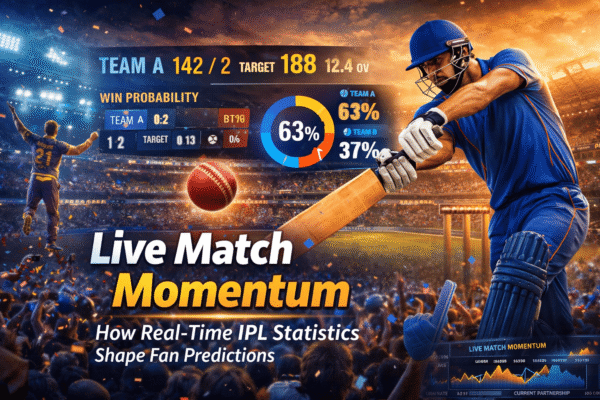
Live Match Momentum: How Real-Time IPL Statistics Shape Fan Predictions

IPL matches do not feel stable for long. One over changes the mood. A quiet powerplay becomes a collapse. A slow chase turns explosive in six balls. That speed is why live statistics matter so much. Fans do not watch numbers passively. They use them to build predictions in real time. A rising run rate suggests control. A cluster of dot balls suggests pressure. A strike rate above 180 changes how viewers read the next over. The scoreboard becomes more than record. It becomes evidence. This is how momentum works in T20 cricket. Momentum is not magic. It is the visible pattern of small events stacking quickly. A boundary, a wicket, a dropped catch, a tight over. Each event shifts belief. Live IPL statistics sharpen that shift. They give fans concrete signals during uncertainty. Instead of saying “this team feels ahead,” viewers can point to the required rate, the death-over economy, or the left-right batting combination at the crease. This article examines how real-time IPL numbers shape fan expectations, why momentum feels stronger in short-format cricket, and how live data turns spectators into active interpreters of the match. Why Real-Time Numbers Change How Fans Read The Match Live cricket statistics act like signals on a dashboard. They tell viewers what direction the match is moving before the result appears. In T20 cricket, the scoreboard updates every ball. That speed creates a constant flow of information. Fans watch the numbers and adjust their expectations immediately. The run rate is the first signal. A batting side scoring nine runs per over looks stable. If that rate drops to six within three overs, the mood changes. Viewers sense pressure building. Even without commentary, the numbers reveal the shift. The required run rate works the same way during a chase. If a team needs eight runs per over, the task looks manageable. If the requirement climbs to twelve, the match suddenly feels fragile. Each dot ball now carries weight. Strike rate also changes perception. A batter scoring at 200 forces bowlers to react. Field placements change. Fans anticipate boundaries before they happen. These rapid updates create a rhythm similar to other fast-feedback digital environments. Viewers respond instantly to every change, much like players react while engaging with instant games online, where outcomes appear immediately and each moment reshapes expectations. In IPL matches, this quick feedback loop keeps attention locked. Fans are not waiting for the final result. They interpret every over as a new probability moment. Real-time statistics therefore turn the scoreboard into a prediction tool. The numbers do not guarantee outcomes. They provide clues about momentum. Run Rate, Strike Rate, And The Language Of Momentum Fans read momentum through three simple numbers. Run rate. Strike rate. Required rate. These numbers act like weather signals in cricket. They show the direction of the match before the storm arrives. Run Rate Shows Control Run rate measures scoring speed across the innings. A team scoring at ten runs per over controls the tempo. Bowlers feel pressure. Fielding captains adjust quickly. Fans sense dominance. When the rate drops below seven in T20 cricket, tension appears. The batting side must rebuild momentum. A sudden jump in run rate often signals the turning point of an innings. Strike Rate Shows Immediate Impact Strike rate measures how fast a batter scores. A strike rate of 150 means the batter scores quickly but steadily. A strike rate above 200 changes the atmosphere of the game. Fans notice this shift immediately. Each ball now carries the possibility of a boundary. Bowlers must alter line and length. Strike rate therefore reflects individual momentum, while run rate reflects team momentum. Required Rate Creates Pressure The required rate matters most during a chase. If a team needs eight runs per over, the target looks reachable. If the number climbs to fourteen, the pressure multiplies. Every dot ball now feels heavy. Every single run looks insufficient. Fans use this number as a countdown signal. It shows whether the chasing side is gaining control or falling behind. Together, these three numbers create the basic language of IPL momentum. Viewers combine them quickly and form predictions long before the final over begins. The Wicket Factor: How A Single Ball Can Flip Predictions A boundary raises excitement. A wicket changes the entire map. In T20 cricket, wickets act like switches. One dismissal can reverse momentum in seconds. Fans understand this instinctively. When a top-order batter falls early, viewers adjust expectations immediately. The batting side loses stability. New players must rebuild rhythm. The run rate often slows for several overs. The situation becomes even sharper in the middle overs. If a team loses two wickets quickly, the innings shifts from attack to repair. Fans start predicting totals based on survival rather than acceleration. A wicket late in the innings has a different effect. During the final overs, momentum depends on finishing power. When a set batter leaves the field, the incoming player faces pressure instantly. Fans recognize that the scoring pace may drop even if overs remain. This is why live statistics often highlight wickets remaining alongside run rate. The combination tells a clearer story. A team scoring ten runs per over with nine wickets in hand looks comfortable. The same run rate with only three wickets left feels fragile. Fans process these signals rapidly. They understand that the scoreboard does not show only runs. It shows structural strength. Because of this, a single ball can reshape prediction patterns across the entire match. Why Live Data Turns Fans Into Match Analysts Live IPL statistics change the role of the viewer. Fans no longer watch the game as passive spectators. They read the scoreboard like analysts. Every number becomes a clue about the next phase of the match. Run rate reveals tempo. Strike rate highlights impact. Required rate exposes pressure. Wickets show structural strength. Together these numbers form a real-time decision map. The speed of T20 cricket amplifies this effect. Momentum shifts quickly. A single over can change projections for…

Read More
Biggest Rivalrie

Biggest Rivalrie: History of Heated Competition Between Franchises and Stars

If there is one thing related to sports that makes the year 2026 special, it is how much high quality cricket there is, and has been. With the ICC T20 Men’s World Cup behind us and India capturing their record setting third title, they also became the first to win the trophy in their home country and the first to defend the title. After such a success, it will be the ladies’ turn to do the same, or at least try, when the ICC T20 Women’s World Cup comes on June 12 to July 5. But before then, the ongoing month of March continues bringing T20 cricket of the highest order with the newest, 19th edition of the Indian Premier League. Perfectly positioned to bridge the gap between the two World Cups, the newest season promises to be one of the most important ones in recent years. The main reason for it is the increased number of total matches. What had been 74 matches per season will not jump to 84. On the surface, this does not seem like a huge change, but in reality, that could not be further from the truth. A whole 10 more games can complicate so much in the best way possible. Teams will have to change their strategies and prepare for the additional workload for a more demanding season that will feel much longer the first time around. In addition, there will be extra action for the fans as there are more chances for betting on cricket matches, as they follow the increased number of clashes between the iconic tournament franchises. How will this affect the postseason, and who will fare best? One thing is sure: the legendary rivalries will only get more heated, which is exactly what we talk about here and now. Historic Cricket Rivalries The Indian Premier League has developed some of the most passionate and dramatic rivalries in modern cricket and sports in general. Since its launch in 2008, the league has not only been a competition between franchises but also a clash of cities, regions, fan bases, star players, and cricketing philosophies. Certain matchups have produced high stakes games, playoff showdowns, and emotional fan reactions that turned them into heated staples in the tournament. What follows is a detailed examination of the biggest rivalries, the history between franchises, head to head statistics, and comparisons in titles and achievements. Super Kings vs Indians: The “El Clásico” of the tournament The rivalry between the Chennai Super Kings and the Mumbai Indians is widely considered the greatest  history and one of the biggest in cricket overall. Both franchises are the most successful teams in the league with 5 trophies each and have consistently competed for championships since the earliest years of the tournament. Out of the 18 titles so far, 10 have been shared between them. Fan bases of both, as well as neutral fans, have their yearly matchups circled on the calendar. The two teams first faced each other in 2008 during the inaugural season. Since then, their matches have often decided the fate of seasons, including several playoff encounters and four IPL finals. The clash between these teams is frequently described as the IPL’s equivalent of a football “El Clásico” because of the immense stakes and global viewership. If there were ever the equivalents of Real Madrid and FC Barcelona in cricket, these two teams are it. In terms of head to head results, the Mumbai Indians hold a slight advantage. As of 2025, the teams have played 39 IPL matches, with Mumbai winning 21 and Chennai winning 18. The rivalry is notable not just for the number of matches but also for their closeness and the frequency with which the games are decided in the final overs. Their games are always hard fought and intense, and there is never a dull moment while you watch on and marvel at how much it means to the players (and the staff). The rivalry’s intensity is amplified by their four legendary battles in IPL finals. These teams met in four championship matches in 2010, 2013, 2015, and 2019. Chennai won the first final in 2010, while Mumbai triumphed in the other three, including the dramatic 2019 final that was decided by just one run. Due to this, the Super Kings are considered more successful than the Indians because they beat their fiercest rival when it mattered most: a direct battle for the title.  The fact that they have both won five IPLs is that much more important considering they are 3-1 in directly denying each other the trophy. This rivalry is also defined by iconic players and leadership that were both the cause and the result of the rivalry at different times. Chennai’s long time captain MS Dhoni built a reputation for calm tactical control, while Mumbai was driven by star studded squads and aggressive leadership under Rohit Sharma. Their clashes have featured numerous memorable performances, making every meeting a marquee event. If you ever want to know how to make money cricket betting, you should start by picking these sorts of matches as they have the most markets and the best odds. Super Kings vs Royal Challengers Another famous rivalry that involves the Chennai Super Kings is the one that they have with the Royal Challengers Bengaluru. While this matchup has historically been less balanced in results and trophies, it remains one of the most emotionally charged rivalries in the league because of the enormous fan bases behind both teams and the legendary players that have represented their colors and defended their honor. The rivalry is closely associated with the long standing captaincy duel between MS Dhoni and Virat Kohli, two of the most recognizable figures in modern cricket who both transcend the limits and boundaries of their beloved sport. Their teams often produced high scoring thrillers, especially when matches were played in Bengaluru at the batting friendly grounds of the M. Chinnaswamy Stadium. If one were ever to witness…

Read More
Indibet Data Study

Indibet Data Study: RCB Home Match Momentum and Odds Fluctuation

In India, cricket is more than a sport because it serves as a national obsession that generates economic activity, while its competitive elements now operate as a system that uses data to connect performance analysis with betting-market operations.  The Royal Challengers Bengaluru (RCB) franchise of the IPL gains unexpected match outcome predictions by studying how momentum and betting odds change during their home games. You can choose online betting IPL sites to earn from the comfort of your home. This blog explores RCB home match momentum and odds fluctuation.  What are Momentum and Odds in Cricket Betting? Momentum in cricket represents the mental and tactical benefits that teams acquire during crucial match moments which include their strong partnerships, their fast two-over performances and their important wicket achievements and their exciting powerplay displays. The betting markets use momentum to determine how odds change throughout a game. Betting odds work by showing lower probabilities for favourite teams and higher probabilities for underdog teams. Indibet’s live betting markets display odds that change instantly in response to match events, including early wickets, major partnerships, and player strike rates.  Momentum indicates the current game status by showing whether one team is winning or losing control of the match. The ability to identify momentum shifts in T20 cricket matches in IPL betting sites which change within two overs becomes essential for bettors who wish to profit from real-time odds adjustments. RCB’s Home Match Performance Has Been Inconsistent RCB has achieved strong results in recent IPL seasons, but their home performances have been inconsistent. The franchise has recorded lower performance at M. Chinnaswamy Stadium, their home ground than at their away grounds. One season’s performance data showed that RCB won only two home matches as they historically failed to win at Chinnaswamy despite their success in other venues. The home paradox at Indibet causes oddsmakers to set RCB’s home betting odds more conservatively than their overall team performance would suggest, because they doubt RCB’s ability to win games at Chinnaswamy after building game momentum. Pre-Match Odds and Form Factors RCB match odds in pre-match markets change significantly based on team performance, available players, and current pitch conditions. The initial match odds on IPL betting sites serve as the base metric for monitoring shifts in match momentum throughout the game. In-Play Odds: The Real Test of Momentum Any Indibet data study reaches its fundamental point through its examination of current live betting markets. During an IPL match: The combination of momentum and odds creates excitement for users of live platforms such as Indibet as betting odds change based on performance and player contributions that evolve throughout the match. How Bettors Can Use Momentum and Odds Studies Understanding momentum’s impact on betting odds requires knowledge of actual odds movements, which extend beyond basic run total and historical data analysis. Limitations and Safe Practices Advanced data analysis shows that betting odds impose restrictions that eliminate the chance of winning.  The correct way to handle betting requires complete responsibility because you must identify all statistical dangers that exist, and you should not depend on current performance trends. Winding It Up RCB’s home momentum and shifting odds reveal how timing and data shape smarter betting decisions. Turn these insights into winning opportunities with Indibet, your trusted platform for seamless cricket action and thrilling live casino experiences. Download Indibet now and start winning with secure, fast, and rewarding gameplay. Sign up instantly to claim bonuses and enjoy nonstop sports entertainment. 

Read More